

Manchester has been crowned the UK’s most AI-ready city in 2026, according to new research.
For the third consecutive year, Manchester has topped the rankings in the SAS AI Cities 2026 Index, maintaining its leadership position through a combination of educational strength, business activity and AI employment.
The annual index, now in its fifth year and delivered by data and AI company SAS, evaluates cities outside of London across eight key criteria, including job opportunities, innovation funding secured, education opportunities, broadband speed, and business activity in the AI sector.
Manchester’s position in top spot can be attributed to its high integration of AI enterprises. Manchester hosts the highest number of AI businesses in the index, with 655 organisations recorded, overall representing 2.8% of its entire business landscape.
Manchester also boasts one of the strongest levels of AI employment outside London (AI-related jobs within a five-mile radius), and is second overall to neighbouring Salford which likely dominates due to being home to Media City. There is also significant InnovateUK investment activity in the city, averaging more than £279,000 per business for AI and Data Economy grants.
The city also tracks a high number of graduate outcomes in computing and engineering disciplines. Interestingly, new ‘MEGA hubs’ are set to be rolled out as a collaboration between Salford-based IN4 Group and the Greater Manchester Combined Authority, providing more than 3,000 secondary school pupils with access to technology learning and an AI Academy. This follows a launch in Oldham, with hubs due to be rolled out across Rochdale, Salford, Tameside and Wigan.
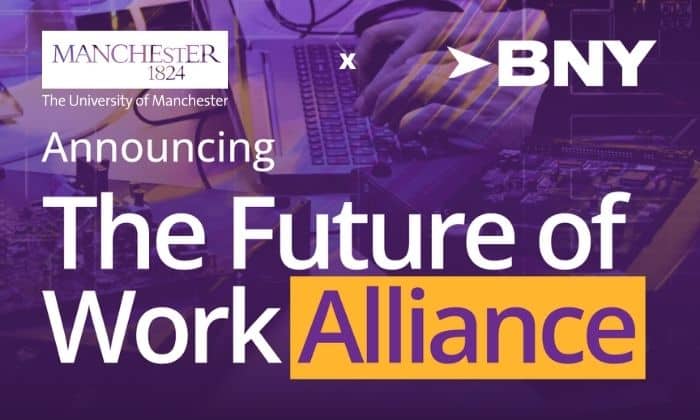
Furthering Manchester’s devotion to advancing the integration of AI within the city, the Future of Work Alliance which was announced at the end of May, is a five-year, £5 million initiative focused on advancing how human-led digital transformation can be integrated into large, data-intensive organisations in the AI era. The scheme will focus on research challenges, offering bespoke academic programmes, postgraduate internships, and support for five AI-focused scholarships, as well as a keynote lecture series.
Aside from educational advancements, significant funding is also going into Manchester’s business scene. The University of Manchester’s Unit M Deep Tech Accelerator recently launched, helping researchers and founders turn AI and science innovation into commercial businesses across areas including AI, biotech and climate tech. Similarly, Manchester City Council has approved a budget exceeding £1 billion for the first time, which will support infrastructure, development and long-term growth initiatives.
Bristol has climbed the ranks since last year’s index, moving up to second place from fourth. They city receives strong R&D funding, has excellent broadband infrastructure and boasts one of the highest concentrations of AI-related businesses.
Much like Manchester, Bristol’s strength lies in its collaborative work with the University of Bristol and local tech businesses. Due to this collaboration, the city is helping to commercialise research into areas like machine learning, robotics and quantum technologies, with Bristol being home to one of the UK’s largest concentrations of microchip and semiconductor companies.
Bristol’s AI maturity is only set to strengthen, as the University of Bristol has recently announced plans to develop a new National AI Data Facility alongside Isambard-AI, the UK’s most powerful supercomputer.
Birmingham rose from sixth to fifth position, mainly due to the city having the largest number of AI-related university courses and continued growth in AI jobs and innovation activity.
For the first time, Derby has entered the UK’s top 20, ranking in 13th place overall. Home to powerhouses like Rolls-Roye and Network Rail, the city recorded the highest average InnovateUK funding per business of all locations included in the index, securing more than £2.6 million per business.
Following in Derby’s footsteps, Southampton experienced a huge jump into the top 10, rising from 26th place to 7th. A high proportion of council staff have AI and data related roles, and Southampton also fared among the best for InnovateUK support, at an average of £330,000 per business.
SAS top 10 AI cities 2026
1 – Manchester
2 – Bristol
3 – Glasgow
4 – Oxford
5 – Birmingham
6 – Southampton
7 – Edinburgh
8 – Leeds
9- Liverpool
10 – Cambridge
Glyn Townsend, Senior Director of Education Services at SAS for Europe, the Middle East and Africa said: “Manchester’s retention of the top spot for the third consecutive year is a testament to the strength of its AI ecosystem. Our previous research affirmed Manchester as a great place for AI businesses to plant their flags, but moving into 2026, it is clear that the city is actively working to grow its AI offerings and ensuring that future talent, as well as existing, is educated to a standard that will not only maintain but exceed what is already happening.
“It’s great to see so much development in other cities too, proving that AI excellence doesn’t need to be London-centric. The likes of both Southampton and Derby, which have rapidly risen through the rankings, shows that cities are embracing and harnessing AI, recognising how it can be used to boost jobs, increase opportunities and assist in long-term economic growth.
“I’m proud that SAS is a founding partner in the UK Government’s initiative to train 10 million workers with the essential skills needed in AI and tech over the next five years – part of the Plan for Change and the forthcoming Industrial Strategy. SAS will provide businesses with free training materials and access to its AI experts.”
Kanishka Narayan, AI Minister at the Department for Science, Innovation and Technology, said: “While congratulations are due for Manchester topping the tables for the third year running, what this report really shows is how AI is creating opportunities for learning, growth and innovation right across the UK.
“We’re mobilising the UK’s businesses, innovators, and our trade unions to unlock AI’s potential for Britain – with more than £200 million earmarked for work that will drive responsible AI adoption in every part of the country.”
Readers can find the full report here.
Methodology
SAS looked at eight key indicators, including:
- Graduate outcomes in computing and engineering subjects, according to HESA (Higher Education Statistics Agency)
- AI-related jobs within a five-mile radius, according to Indeed
- Average broadband speeds available to businesses
- Average Innovate UK funding awarded per business (2025/26), based on AI and Data Economy funding
- Number of AI businesses in each city, according to LinkedIn
- Proportion of businesses focused on AI, using ONS enterprise figures to benchmark against LinkedIn figures
- The number of city council staff employed which reference AI, automation, digital transformation, data analysis or data scientist
- Number of university courses referencing artificial intelligence, according to UCAS
Cities received weighted scores across all categories to produce an overall AI readiness score.
Data correct as of 2026.